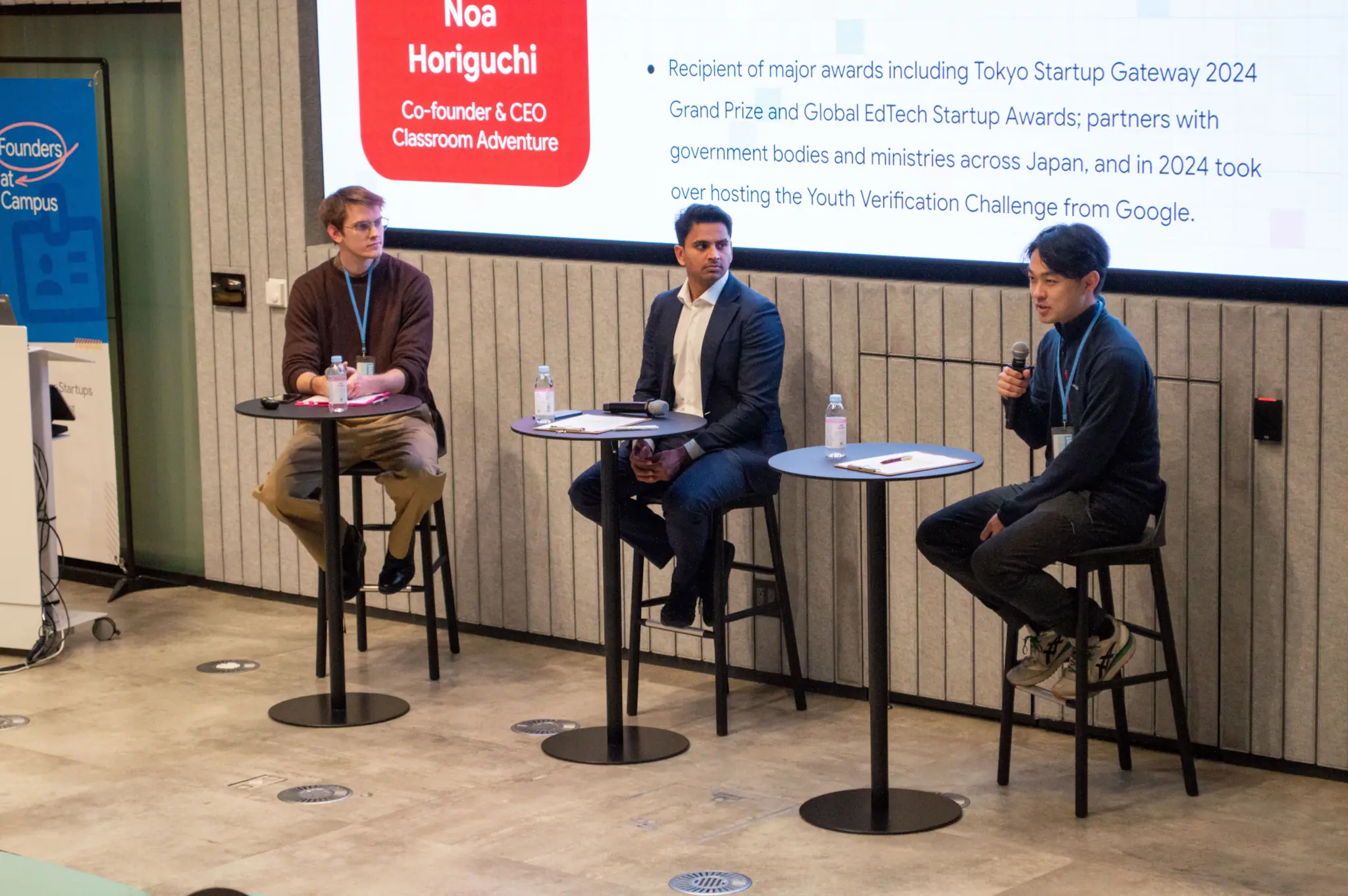
Japan is on track to become the world’s first super-aged society, with one in three citizens soon to be over 65. But for three founders working at the frontlines of longevity, health, and community, this demographic shift is one of the most compelling innovation opportunities of our time. At the inaugural Changemakers Unplugged event, hosted in collaboration by Impact HUB Tokyo and Google for Startups, a panel of founders shared hard-won lessons from building products and services for ageing-related markets, where the rules of user testing, distribution, and scale look very different from typical consumer tech. Changemakers Unplugged is an event series exploring how founders and ecosystem partners in Japan are tackling some of society’s most pressing challenges, through honest conversation and real stories.
The speakers were Tomoe Ueyama, founder of Project MINT; Akira Higuchi of CogSmart; and Shoko Kamiyama, founder of SHOSABI – each a practitioner who has built products and services in a domain where the rules of user testing, distribution, and scale differ significantly from conventional consumer tech. The discussion, moderated by Chris Clayton from Impact HUB Tokyo, unfolded across three themes: “reframing aging as an opportunity,” “the on-the-ground realities of product development,” and “pathways to sustainable scale and social implementation.”
Here are the key takeaways from the evening’s conversation.
Japan as a global testbed, not just a local problem
Panelists emphasized that Japan’s ageing trajectory isn’t unique, but rather ahead of the curve. Countries across Asia, Europe, and beyond will face similar demographic realities within the next two decades. The founders framed Japan as a living laboratory where solutions can be prototyped, validated, and eventually exported. What works here has the potential to shape how the rest of the world responds to its own ageing future.
Rethinking who the “user” really is
A recurring theme was how deeply the ageing market challenges conventional startup thinking about users. Tomoe Ueyama, founder of Project MINT, highlighted how mid- and late-career professionals are often overlooked as a demographic with agency, ambition, and untapped potential. Her work redefining second careers for professionals beyond retirement age pushes back against the assumption that older adults are passive recipients of care, showing instead that age can be a force for creativity and leadership.
Measurement before intervention
Akira Higuchi of CogSmart brought a research-grounded perspective on cognitive health and longevity. Drawing on over 25 years of dementia prevention research from Tohoku University, he stressed the importance of measurement-guided interventions, understanding where someone is before designing how to help them. He also spoke candidly about the challenges of operating at the intersection of academia and business: two worlds with very different incentives, timelines, and definitions of success. For university spin-offs like CogSmart, translating rigorous research into viable products means constantly bridging that gap.
The body knows, if we learn to listen
Sachiko Kamiyama, founder of SHOSABI, brought a different lens to longevity: movement. Spun out of Mitsubishi Chemical Group, SHOSABI uses AI-driven motion sensing to detect and correct subtle physical misalignments before they cause damage. Her insight was that longevity innovation doesn’t have to mean high-tech intervention in a clinical setting it can start with something as fundamental as helping people move better in their everyday lives. SHOSABI is already deployed in gyms and wellness clinics in London, Dubai, and beyond.
Partnerships are the product
All three panelists pointed to partnerships, with local governments, medical institutions, corporates, and community organizations, as essential infrastructure for building in the ageing space. Unlike typical B2C or B2B tech, products for ageing populations often need to be embedded within existing trust networks. The panel agreed that forming and maintaining these partnerships is 80% of the work.
What gives us hope
The evening closed with each speaker reflecting on what gives them optimism. The consensus: Japan’s combination of advanced infrastructure, cultural respect for elders, and a growing ecosystem of mission-driven founders makes it uniquely positioned to lead in longevity innovation. The challenge is moving beyond incremental improvements and embracing bolder, more human-centered approaches to how we live, work, and age. Changemakers Unplugged is an event series by Impact HUB Tokyo exploring how founders and ecosystem partners are tackling some of society’s most pressing challenges, through honest conversation, real stories, and a commitment to building what matters.